

Why Your Water Heater Is Not Heating and What to Do About It
A water heater not heating is one of the most frustrating problems a homeowner can face: cold showers, no hot water for dishes, and no clear answer about why.
Here are the 8 most common causes:
| # | Cause | Type |
|---|---|---|
| 1 | Tripped circuit breaker | Electric |
| 2 | Extinguished pilot light | Gas |
| 3 | Faulty thermocouple | Gas |
| 4 | Failed heating element | Electric |
| 5 | Malfunctioning thermostat | Both |
| 6 | Heavy sediment buildup | Both |
| 7 | Broken dip tube | Both |
| 8 | Undersized unit or high demand | Both |
Most of these problems have a clear fix, and some you can handle yourself in under 30 minutes.
This guide walks you through each cause, how to diagnose it, and when it’s time to call a professional.
At Holloway Plumbing, our water heater team has responded to countless calls about a water heater not heating, from a simple tripped breaker to a heating element buried under two inches of calcified sediment. The patterns are consistent, and knowing what to look for makes all the difference.

What to Check First When Your Water Heater Is Not Heating
Before you panic and prepare yourself for a massive replacement bill, take a deep breath. Often, the reason behind a water heater not heating is something incredibly simple that doesn’t require a single tool to diagnose.
When you realize your hot water is gone, the temptation is to immediately start looking up replacement units. Instead, run through these quick preliminary checks:
- Check the power source: For electric systems, go directly to your home’s main electrical panel. For gas systems, check if other gas-powered appliances in your home, like your stove or fireplace, are working.
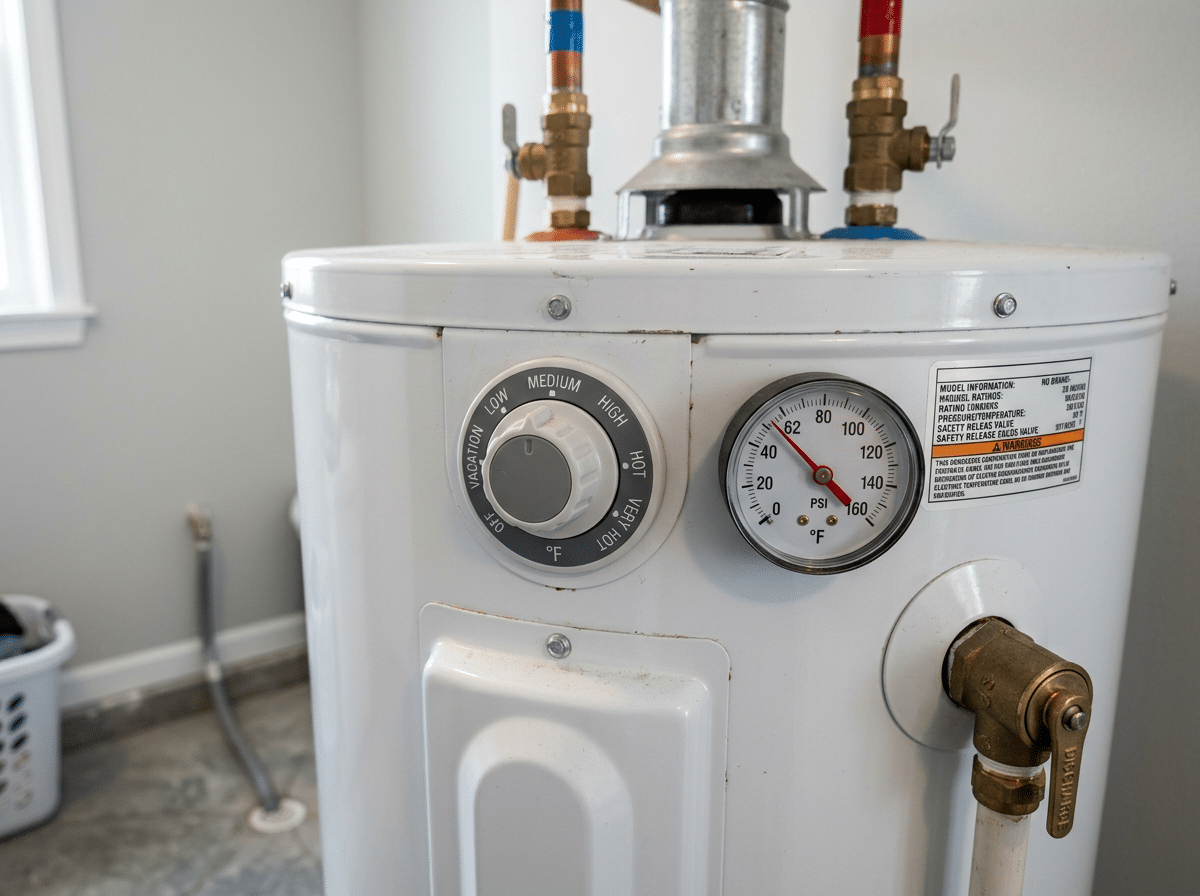
- Inspect the thermostat settings: Ensure the temperature dial on your water heater hasn’t been accidentally bumped down. It should ideally be set between 120°F and 140°F.
- Look for physical leaks: Walk over to your utility closet or garage. Is there water pooling around the base of the tank? If so, you might be dealing with a structural issue.
If you wake up to a freezing surprise, our breakdown of what to do when your hot water suddenly stops working can help you narrow down the problem before you decide whether to call for service.
1. Tripped Circuit Breaker on an Electric Water Heater Not Heating
If you have an electric water heater and the hot water has completely vanished overnight, the absolute first suspect is a tripped circuit breaker.
Electric water heaters are heavy-duty appliances. They require a dedicated 240-volt circuit, usually controlled by a double-pole 30-amp or 40-amp breaker. Because they draw so much power, a sudden electrical surge or even a minor fluctuation in your local Hill Country power grid can cause the breaker to trip to prevent an electrical fire.
When this happens, the heater loses all power instantly. To fix this, locate your home’s main breaker panel. Look for the switch labeled “Water Heater.” Even if it doesn’t look completely flipped to the “OFF” position, push it firmly to “OFF” first, and then flip it back to “ON.” If the breaker trips again immediately, do not force it. This is a sign of a deeper electrical issue, such as a shorted heating element or a compromised wire, and requires professional diagnostic work from a team that handles water heater services in Kerrville, TX.
2. Extinguished Pilot Light on a Gas Water Heater Not Heating
For those with a gas water heater, a sudden loss of hot water usually points to an extinguished pilot light.
The pilot light is a small, continuously burning flame that ignites the main burner assembly when the thermostat calls for heat. If this flame goes out, the gas control valve will automatically shut off the gas supply to prevent dangerous gas leaks into your home.
Why does a pilot light go out?
- Drafts: A sudden gust of wind down the flue pipe or through a drafty utility closet can easily blow the flame out.
- Dirty Burner Assembly: Debris or carbon buildup can choke the pilot burner opening, preventing gas from flowing smoothly.
- Interrupted Gas Supply: A temporary drop in gas pressure can cause the flame to flicker out.
Fortunately, modern gas water heaters have clear instructions printed right on the tank explaining how to safely relight the pilot.
3. Faulty Thermocouple
If you try to relight your gas pilot light and it goes out the moment you let go of the control knob, your thermocouple is likely the culprit.
The thermocouple is an essential safety sensor. It is a small metal rod that sits directly in the path of the pilot flame. As long as the flame is burning, the thermocouple generates a tiny electrical current that signals the gas valve to stay open. If the thermocouple is bent away from the flame, covered in soot, or completely broken, it won’t detect the heat.
As a safety precaution, the system assumes there is no flame and shuts down the gas supply. Thermocouples are inexpensive parts, but replacing one requires working closely with gas lines, which means many homeowners prefer to leave this task to licensed professionals.
4. Failed Heating Elements
Electric water heaters rely on two electrical resistance heating elements inserted directly into the tank: an upper element and a lower element. These elements operate using a system called sequential heating.
When cold water enters the tank, the upper element turns on first to heat the top portion of the water. Once that water reaches the set temperature, the upper thermostat switches power down to the lower element to heat the rest of the tank.
If one of these elements fails, you will experience distinct symptoms:
- Failed upper element: You will have no hot water at all, because the heating cycle never progresses.
- Failed lower element: You will have a short supply of hot water that runs cold very quickly, as only the top portion of the tank is being heated.
Elements can burn out over time due to normal wear and tear, or they can suffer from “dry-firing.” Dry-firing occurs if power is restored to a water heater before the tank is completely filled with water, instantly melting the element.
5. Malfunctioning Thermostats
Just like heating elements, electric water heaters feature two thermostats (upper and lower) designed to monitor water temperatures and regulate power.
If the upper thermostat fails, the entire system shuts down, leaving you with zero hot water. If the lower thermostat malfunctions, your water might only get lukewarm or overheat dangerously.
Additionally, electric water heaters are equipped with a high-limit safety switch, often referred to as the ECO (Energy Cut Off) button. This is a red button located on the upper thermostat assembly. If a power surge occurs or the water temperature inside the tank spikes dangerously high, the ECO button trips and cuts all power to the elements. While you can reset this button manually, a safety switch that trips repeatedly is a clear warning sign of a failing thermostat or element that needs immediate attention.
6. Heavy Sediment Buildup
If you live in the Texas Hill Country, whether in Kerrville, Fredericksburg, or Boerne, you are likely very familiar with hard water. Our local water supply is rich in dissolved minerals like calcium and magnesium. Over time, as water is heated, these minerals settle out of the water and accumulate at the bottom of your water heater tank.
This sediment buildup acts as a thick, calcified thermal blanket.
- In gas heaters: The sediment insulates the bottom of the tank, preventing the burner flame from efficiently heating the water. This forces the burner to run longer, overheating the metal tank bottom and eventually causing it to crack and leak.
- In electric heaters: The sediment can completely bury the lower heating element, causing it to overheat and burn out.
If you hear loud popping, rumbling, or sizzling noises coming from your utility closet, that is the sound of water boiling underneath a thick crust of mineral sediment. If left unchecked, this can lead to structural failure, including the tank damage described in our article on why water heaters start leaking.
7. Broken Dip Tube
Have you noticed that your water starts out hot but turns lukewarm or cold within just a couple of minutes? If your heating elements and thermostats are working perfectly, you might have a broken dip tube.
The dip tube is a long plastic pipe that runs from the cold water inlet at the top of the tank all the way down to the bottom. Its job is to deposit incoming cold water directly at the bottom of the tank, where the heating elements or gas burners can heat it.
If the dip tube cracks, breaks, or disintegrates, cold water will empty out near the top of the tank instead. This cold water mixes directly with the hot water waiting to exit the tank, resulting in a lukewarm shower. To understand the mechanical issues that can occur inside your tank, read our post on the Troubles behind water heater leaking.
8. Undersized Unit or High Demand
Sometimes, a water heater not heating isn’t broken at all. It’s simply overwhelmed.
Every home has a specific hot water demand based on household size and appliance usage. If you have a 40-gallon tank but your family has grown, or if you are running the dishwasher, washing machine, and shower at the same time, you will quickly exhaust your hot water supply.
Traditional tank systems require time to recover and heat a fresh batch of cold water. If your household has outgrown its current system, it might be time to discuss upgrading to a larger tank or switching to a highly efficient tankless model. For homes comparing repair versus replacement, Holloway Plumbing can help you evaluate whether water heater replacement for family homes makes more sense than another short-term fix.
Step-by-Step Troubleshooting and DIY Fixes
If you are comfortable with basic home maintenance, you can troubleshoot several of these issues yourself.
Before attempting any DIY repairs, always prioritize safety. Working on a water heater involves high-voltage electricity, natural gas, and scalding water.
- For electric heaters: Always turn off the dedicated breaker at your main panel and verify the power is off using a non-contact voltage tester before removing any access panels.
- For gas heaters: Turn the gas control valve to the “OFF” or “PILOT” position before inspecting the burner assembly. If you ever smell gas, which often has a rotten-egg odor, leave your home immediately and call your gas utility provider.
If troubleshooting points to a failing tank, recurring sediment problems, or unsafe electrical behavior, scheduling professional water heater services in Kerrville, TX is safer than continuing to reset or relight the system.
How to Reset an Electric Water Heater
If your electric water heater has suddenly stopped heating, the high-limit safety switch may have tripped. Here is how to safely reset it:
- Turn off the power: Flip the water heater circuit breaker to the “OFF” position.
- Remove the access panel: Use a screwdriver to remove the upper access cover on the side of the tank.
- Move the insulation: Gently push aside the fiberglass insulation to reveal the thermostat.
- Locate the red button: You will see a red button labeled “RESET” on the high-limit switch.
- Press the button: Push the red button firmly. You should hear a distinct click.
- Reassemble and restore power: Replace the plastic protector cover, insulation, and outer access panel. Turn the circuit breaker back on.
If the button trips again soon after resetting, contact a professional to diagnose why the system is overheating.
How to Relight a Gas Pilot Light
If your gas pilot flame has gone out, follow these steps to relight it safely:
- Turn the gas valve to OFF: Locate the gas control knob on the front of the heater, turn it to “OFF,” and wait at least 5 minutes for any residual gas to clear out.
- Remove the burner cover: Remove the metal access door at the bottom of the tank to view the pilot burner.
- Turn the valve to PILOT: Rotate the gas control knob to the “PILOT” position.
- Depress and ignite: Press and hold the gas control knob down completely. This overrides the safety valve and releases a small stream of gas to the pilot. While holding the knob down, repeatedly press the piezo igniter button until you see a small blue flame light up.
- Hold the knob: Keep holding the gas control knob down for 30 to 60 seconds to allow the thermocouple to heat up.
- Release and turn ON: Slowly release the knob. If the pilot stays lit, turn the control knob to the “ON” position. You should hear the main burner ignite with a gentle roar.
How to Diagnose and Replace Heating Elements
To determine if an electric heating element has failed, you will need a digital multimeter:
- Turn off power: Ensure the circuit breaker is completely off.
- Expose the elements: Remove the upper and lower access panels, peel back the insulation, and remove the plastic covers.
- Disconnect the wires: Use a screwdriver to disconnect the two power wires from the element terminals.
- Test for resistance: Set your multimeter to Ohms ($\Omega$). Touch one probe to each of the two screw terminals on the element. A functioning element should read between 10 and 30 Ohms. A reading of zero or infinity indicates a broken element.
- Test for a short circuit: Touch one probe to a screw terminal and the other probe to the metal body of the water tank. If you get any reading other than infinity, the element is shorted to ground and must be replaced.
- Replacement: If an element is bad, drain the tank, use an element wrench to unscrew the old part, install a new element with a fresh rubber gasket, refill the tank completely, and restore power.
How to Flush Sediment from the Tank
Flushing your water heater tank annually is the single best way to prevent mineral buildup and extend the lifespan of your unit.
- Turn off power/gas: Turn off the breaker for electric heaters, or turn the gas valve to “PILOT” for gas units.
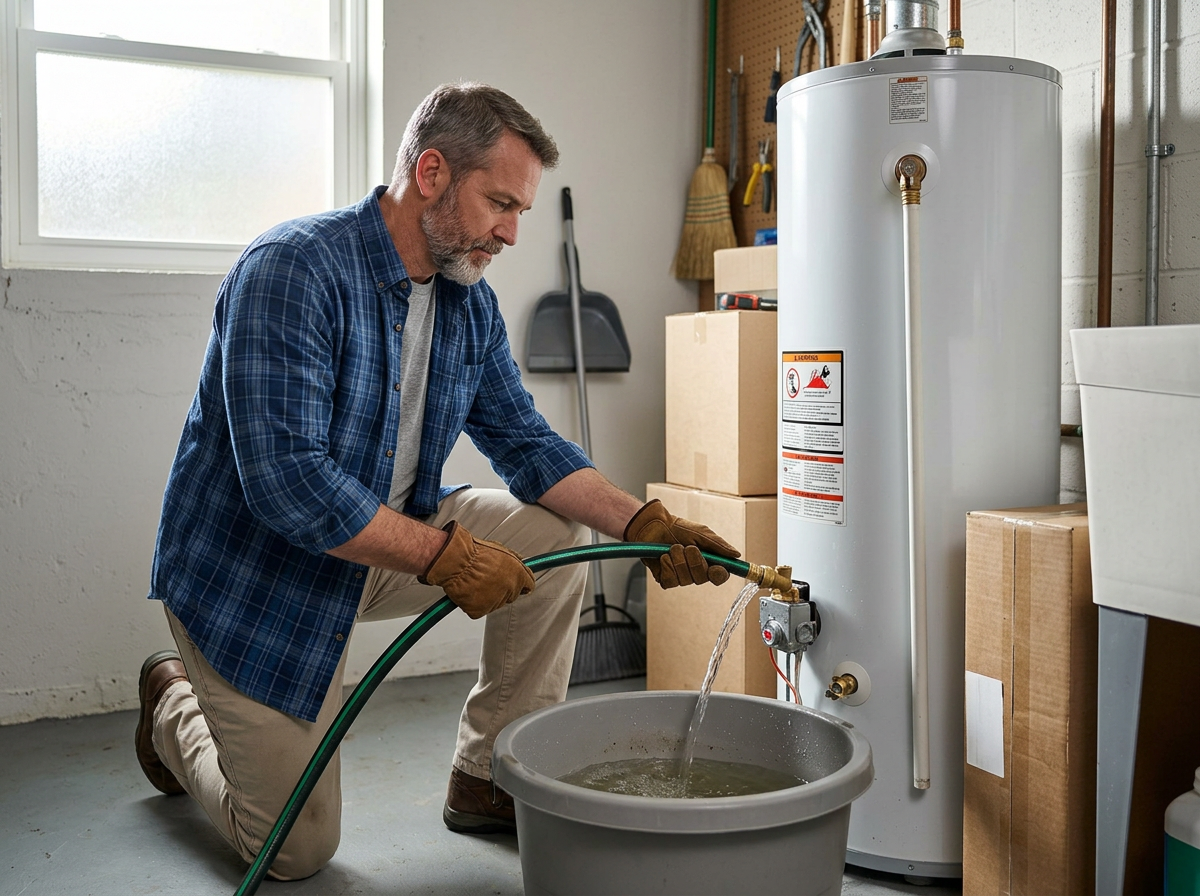
- Connect a hose: Attach a standard garden hose to the drain valve located at the bottom of the water heater. Run the other end of the hose to a floor drain, driveway, or backyard.
- Close the cold water inlet: Turn off the cold water supply valve at the top of the tank.
- Open a hot water faucet: Open a hot water faucet inside your home, like a bathtub faucet, to allow air into the system and prevent a vacuum from forming.
- Open the drain valve: Open the drain valve on the water heater. Let the water drain completely.
- Flush the tank: Once empty, turn the cold water supply valve back on in short bursts. This will stir up and flush out any remaining sediment at the bottom of the tank. Repeat this until the water running out of the hose is crystal clear.
- Refill and restart: Close the drain valve, disconnect the hose, turn the cold water inlet valve completely back on, and wait for the tank to fill. Once water flows steadily from your indoor faucet, you can safely turn the power or gas back on.
Regular maintenance is just as important for tankless systems. If you have a tankless unit, our guide to annual tankless water heater maintenance explains how routine service helps protect water flow, efficiency, and equipment life.
Frequently Asked Questions
Why is my water lukewarm but not hot?
Lukewarm water is usually caused by a broken dip tube, which allows cold water to mix directly with hot water at the top of your tank. In electric water heaters, a burned-out lower heating element will also result in lukewarm water because only the top portion of the tank is being heated.
If you own a tankless system in an older home, lukewarm water can occur if the unit is undersized for your household’s peak water demand.
How long do water heaters typically last?
Standard tank water heaters generally last between 8 and 12 years. Tankless water heaters can last significantly longer, often reaching 15 to 20 years with proper maintenance.
If your tank unit is approaching its 10th year and is experiencing repeated heating issues, replacing it is often more cost-effective than continuing to pay for repairs.
What is the difference between flushing and descaling?
Flushing is a simple maintenance task where you drain a traditional tank water heater to wash out loose sediment like sand and mineral flakes.
Descaling is a more intensive process used for tankless water heaters. It involves pumping a food-grade vinegar solution through the heat exchanger to dissolve stubborn calcium scale buildup that restricts water flow and heat transfer.
Conclusion
A water heater not heating can quickly disrupt your daily routine, but many common causes, like a tripped breaker or an extinguished pilot light, can be resolved with some basic troubleshooting. However, if you are dealing with persistent electrical issues, gas line concerns, or a leaking tank, it is always safest to call in a professional.
At Holloway Plumbing, we have been serving families and businesses across the Texas Hill Country, including Kerrville, Fredericksburg, Boerne, Bandera, Ingram, and Fair Oaks Ranch, for nearly 50 years. We pride ourselves on providing fast, reliable, and expert plumbing services, and we are available 24/7 for emergency repairs.
Don’t stay stuck in the cold. Contact our professional water heater technicians and let our expert team restore your home’s hot water safely and quickly!