
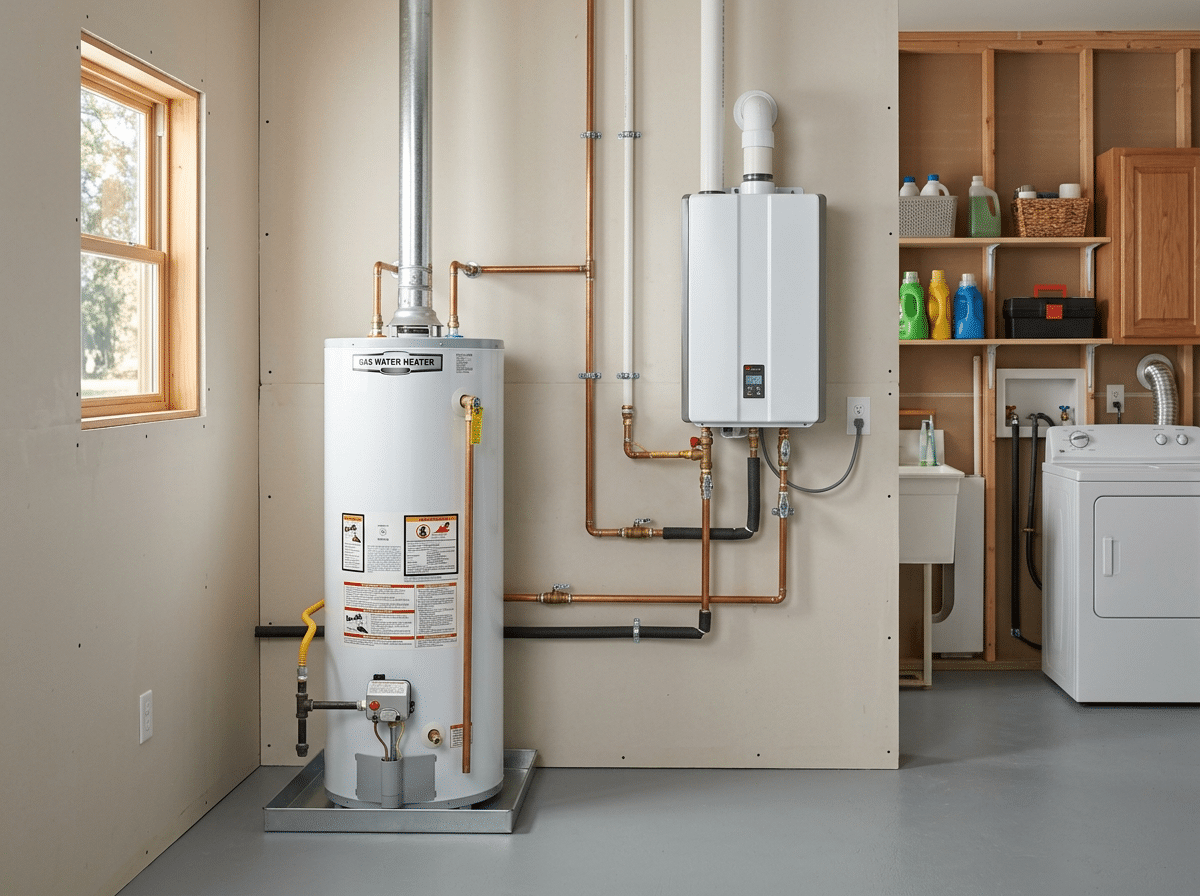

Tank vs. Tankless Water Heater in Kerrville: What Hill Country Homeowners Need to Know
When weighing a tank vs tankless water heater Kerrville decision, the answer isn’t one-size-fits-all. Local hard water, gas line capacity, and household size all change the math significantly.
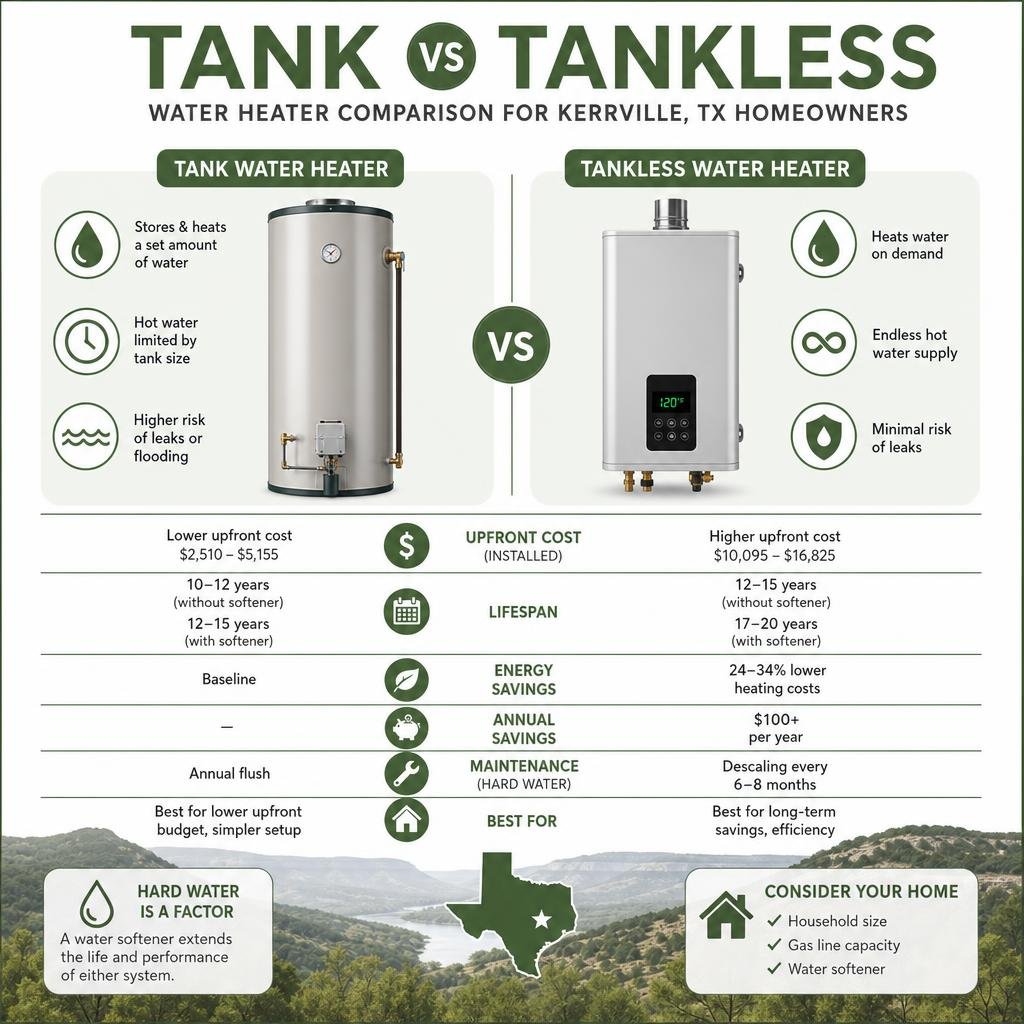
Here’s a quick comparison to help you decide:
| Factor | Tank Water Heater | Tankless Water Heater |
|---|---|---|
| Upfront cost (installed) | $2,510 – $5,155 | $10,095 – $16,825 |
| Lifespan (no softener) | 10–12 years | 12–15 years |
| Lifespan (with softener) | 12–15 years | 17–20 years |
| Energy savings | Baseline | 24–34% lower heating costs |
| Annual savings | — | $100+ per year |
| Maintenance (hard water) | Annual flush | Descaling every 6–8 months |
| Hot water supply | Limited by tank size | Unlimited, on demand |
| Flood risk | Yes (30–80 gallons) | Minimal |
| Best for | Lower upfront budget, simpler setup | Long-term savings, efficiency |
Bottom line: A tankless system saves more money over time, but only if you have a water softener and adequate gas line capacity. Without those, a high-efficiency tank unit may be the smarter near-term choice for most Kerrville homes.
Kerrville’s Texas Hill Country location means hard water is a real factor in every water heater decision. The mineral-heavy water here accelerates scale buildup, shortens equipment life, and increases maintenance costs, especially for tankless systems. Understanding how each system handles these local conditions is key to making the right call.
The Holloway Plumbing team brings nearly 50 years of combined company experience serving the Texas Hill Country, including hundreds of tank vs tankless water heater Kerrville installations and replacements. Our licensed plumbers have seen how local water quality and home infrastructure shape the right choice for each household. Let’s break down exactly what that means for your home.
How Tank and Tankless Systems Work
To make an informed decision for your home, it helps to understand the fundamental engineering differences between these two systems. While both are designed to deliver hot water to your taps, they go about it in completely opposite ways.
Choosing between them isn’t just about picking a product; it dictates how your home uses energy, how much physical space you have, and how you manage your daily routines. For a complete look at your options, Holloway Plumbing offers professional water heater installation services that help Kerrville homeowners choose a system that fits the property, budget, and daily hot water demand.
Traditional Storage Tank Water Heaters
Traditional storage tank water heaters are the dependable workhorses of the plumbing industry. These systems operate on a principle of continuous heating. A large insulated cylinder, typically holding 40 to 50 gallons of water, constantly monitors the water temperature inside. When the temperature dips below your set limit, the system fires up its gas burner or electric heating elements to warm the water back up.
The major drawback here is standby energy loss. Because the tank must keep those 40 to 50 gallons hot 24 hours a day, 7 days a week, it burns energy even when you are asleep, at work, or away on vacation. If you prefer this classic, reliable approach, modern tank models balance dependable storage with improved insulation to minimize that standby loss.
On-Demand Tankless Water Heaters
On-demand tankless water heaters completely eliminate the storage tank. Instead of keeping water hot all day, they remain completely idle until you open a hot water faucet somewhere in your home.
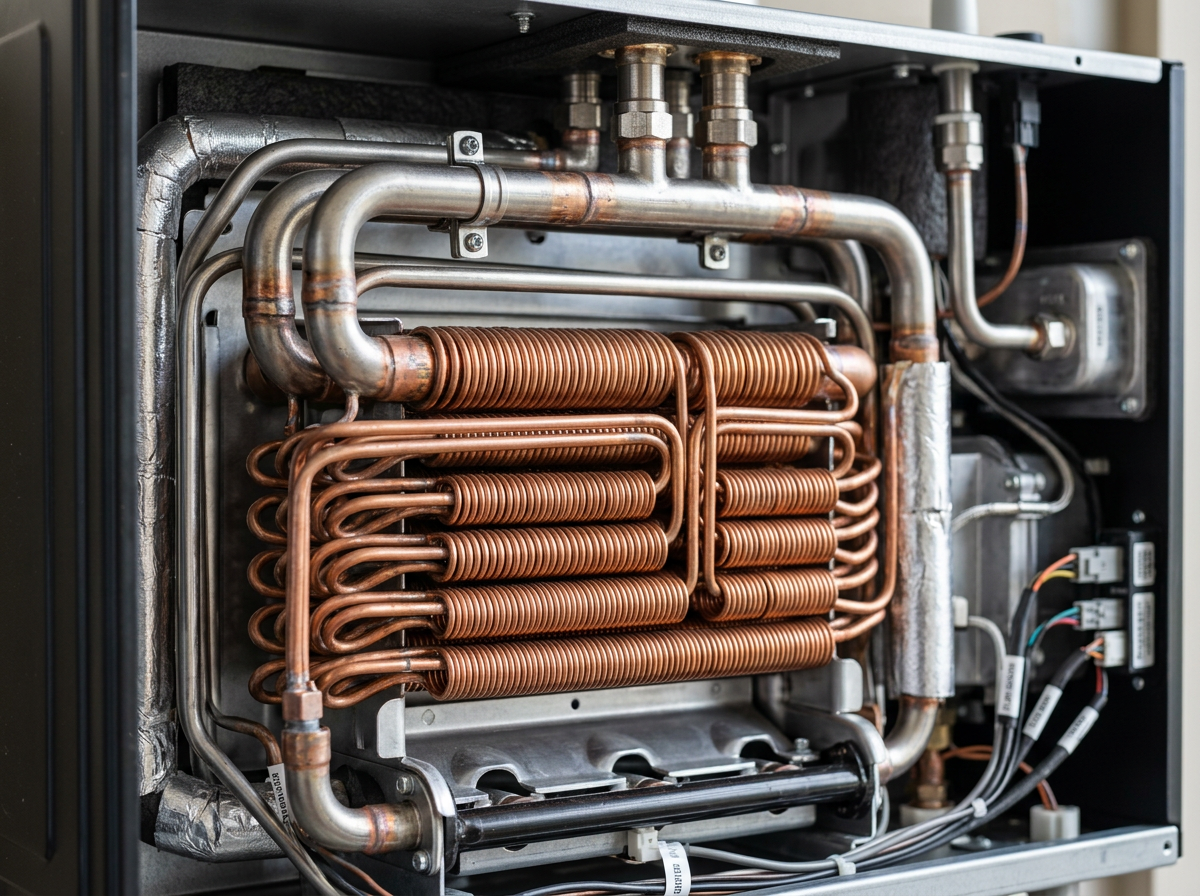
The moment a tap is opened, cold water flows into the unit. A flow sensor detects this movement and instantly triggers a powerful gas burner or electric element. The water is forced through a tightly coiled copper or stainless steel heat exchanger, which rapidly transfers heat to the flowing water.
By the time the water exits the unit, it has reached your target temperature. This process provides a continuous, virtually endless supply of hot water. Additionally, because there is no bulky tank, these units offer incredible space savings, freeing up valuable closet or utility room space. Homeowners interested in making the switch can compare high-efficiency tankless water heaters with a technician who understands how these systems integrate into Hill Country homes.
Sizing and Household Hot Water Demand
Sizing a water heater is vastly different depending on the technology you choose.
- For tank systems: Sizing is based on storage capacity (e.g., a 40-gallon tank vs. a 50-gallon tank) and the “first-hour rating,” which measures how much hot water the tank can deliver in a single hour of peak usage.
- For tankless systems: Sizing is measured entirely by flow rate, calculated in gallons per minute (GPM), and the required temperature rise.
Temperature rise is the difference between the incoming cold groundwater temperature and your desired hot water output (typically 120°F). In the Texas Hill Country, our winter groundwater temperatures can drop significantly. If your incoming water is 60°F, your tankless unit must achieve a 60-degree temperature rise instantly.
If you have a large family trying to run multiple simultaneous showers, a washing machine, and a dishwasher all at once, an undersized tankless unit will struggle. It won’t run out of hot water, but it will reduce water pressure or distribute lukewarm water to keep up with the GPM demand. For families comparing capacity, layout, and usage patterns, Holloway Plumbing explains how to select the right setup in this blog on water heater replacement in family homes.
Tank vs Tankless Water Heater Kerrville: The Hard Water Reality
If you live in Kerrville, Fredericksburg, Boerne, or anywhere else in the Texas Hill Country, you already know we have incredibly hard water. Our water supply travels through deep limestone aquifers, picking up high concentrations of calcium and magnesium along the way.
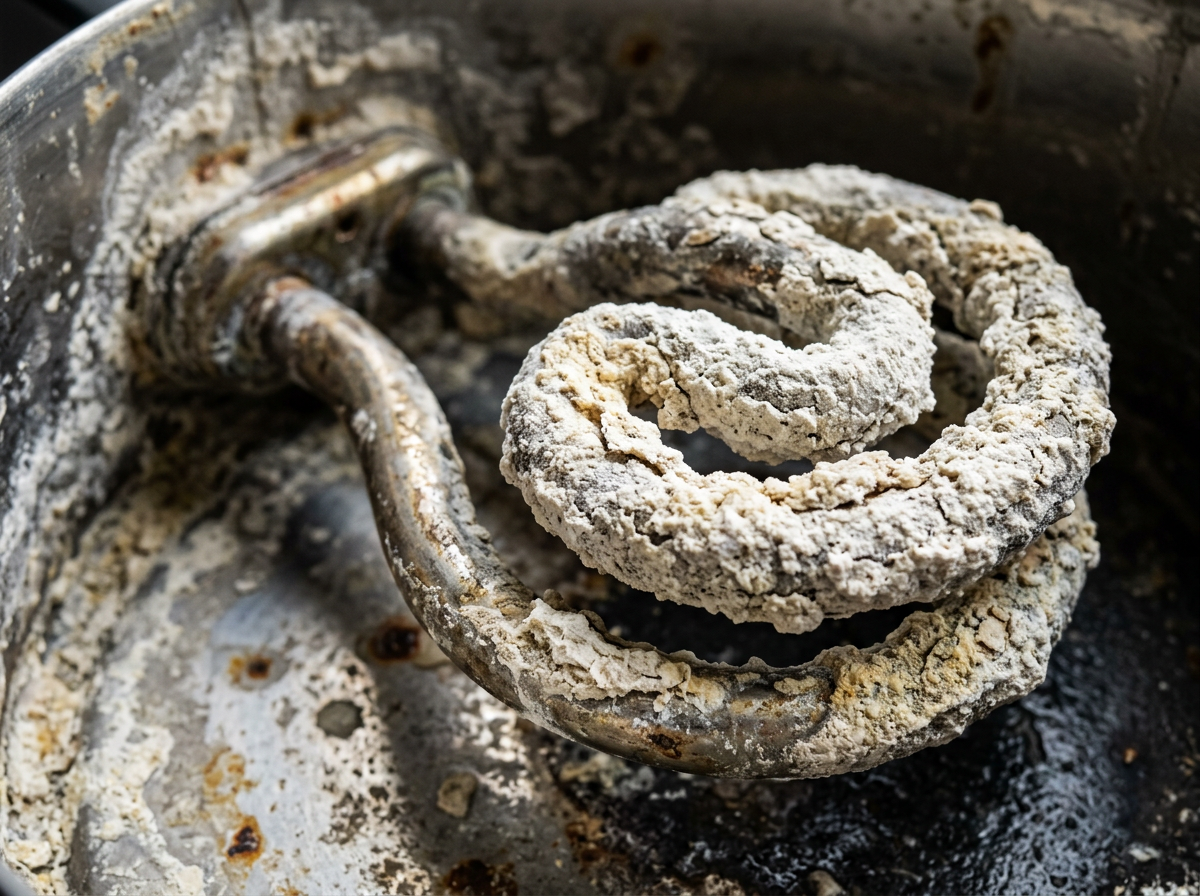
While these minerals are perfectly safe to drink, they are the absolute archenemy of water heaters. When hard water is heated, these minerals precipitate out of the liquid and solidify into a rock-hard crust known as scale. This scale acts as a thermal insulator, coating your heating elements or heat exchangers and forcing your system to work twice as hard to heat the water.
Lifespan and Maintenance with Hard Water
The extreme water hardness in our region dramatically alters the lifespan and maintenance needs of both systems:
-
Without a Water Softener:
- Tank Water Heaters: Typically last only 10 to 12 years. The bottom of the tank fills with mineral sediment, which eventually causes the tank bottom to overheat, crack, and leak.
- Tankless Water Heaters: Typically last 12 to 15 years, but require aggressive maintenance. Without a water softener, a tankless unit in our hard water areas needs professional descaling every 6 to 8 months to clear out scale from the narrow passages of the heat exchanger. Neglecting this can lead to system overheating and premature failure.
-
With a Water Softener:
- Tank Water Heaters: Lifespan extends to 12 to 15 years.
- Tankless Water Heaters: Lifespan jumps to an impressive 17 to 20 years, and the professional descaling interval can safely be extended to once every 12 to 18 months.
Because scale buildup is so aggressive here, regular service is non-negotiable. If you want to keep your system running efficiently, the Holloway Plumbing blog on annual tankless water heater maintenance explains how flushing, descaling, and inspection help protect your investment in Hill Country hard-water conditions.
Cost Comparison: Upfront Investment vs. Long-Term Savings
When evaluating a tank vs tankless water heater Kerrville upgrade, the financial picture must look at both the immediate installation cost and the long-term operational impact.
While a tankless system boasts superior energy efficiency and can lower your utility bills, its higher initial price tag means you must look at the overall return on investment over a 15-year period.
According to the U.S. Department of Energy, homes using tankless water heaters can save 24 to 34 percent on water heating energy costs compared to homes with traditional storage tanks. This translates to an average savings of $100+ per year on utility bills for a typical family.
| Cost Factor | Traditional Tank System | Tankless System (Gas) |
|---|---|---|
| Upfront Installed Cost | $2,510 – $5,155 | $10,095 – $16,825 |
| Annual Fuel/Gas Cost | $250 – $380 | $180 – $280 |
| Annual Descaling (No Softener) | $0 (Self-flush recommended) | $450 – $600 (Every 6-8 months) |
| Annual Descaling (With Softener) | $0 | $150 – $225 (Every 12-18 months) |
| Expected Equipment Lifespan | 10 – 12 years (No softener) | 17 – 20 years (With softener) |
Upfront Purchase and Installation Costs
There is no sugarcoating it: transitioning to a tankless system requires a significant upfront investment. While a high-efficiency 50-gallon gas tank water heater costs $2,510 to $5,155 installed in Kerrville, TX, a whole-home gas tankless water heater costs $10,095 to $16,825 installed on an adequate existing gas line.
Why is the tankless installation so much higher? It rarely is a simple “plug-and-play” swap. Tankless units require:
- Gas Line Upgrades: A traditional tank heater draws roughly 40,000 BTU/hr because it can take its time heating water. A tankless unit requires 150,000 to 199,000 BTU/hr to heat water instantaneously. This often requires upgrading your home’s gas line capacity.
- Specialized Venting: Tankless systems burn gas at high temperatures and produce acidic condensate, requiring dedicated category III or IV stainless steel or PVC venting through your wall or roof.
- Electrical Work: Even gas tankless units require an electrical outlet nearby to power the digital control board and electronic ignition.
If you are replacing an aging unit, Holloway Plumbing can help you weigh these upfront variables, from venting and gas line capacity to the total installed cost of a properly sized system.
Long-Term Operating and Maintenance Costs
Over a 15-year timeline, the operating costs begin to tell a different story. Because tankless units completely eliminate standby heat loss, your annual gas cost will be roughly 20% to 25% lower than with a storage tank.
However, in the Kerrville area, your net savings will be heavily influenced by your water softening setup. If you do not have a water softener, the required twice-yearly professional descaling costs ($450 to $600 per year) will quickly eat into your energy savings. If you do have a water softener, the maintenance costs drop dramatically, allowing you to pocket the energy savings and enjoy a much longer system lifespan.
Frequently Asked Questions about Water Heaters in Kerrville
Navigating the local plumbing landscape in the Texas Hill Country comes with unique challenges. Here are some of the most common questions we hear from homeowners in our service area.
Is a tank vs tankless water heater Kerrville upgrade worth it for older homes?
Upgrading to a tankless system in older Kerrville or Fredericksburg homes is highly rewarding, but it does come with unique retrofitting challenges. Older properties often feature smaller gas meters, 1/2-inch gas lines (where 3/4-inch is needed), or older electrical panels that cannot easily support the power requirements of a tankless unit.
However, the space savings can be a game-changer for historic or smaller homes, allowing you to reclaim a closet or utility area. Before making the leap, older-home owners should account for gas sizing, venting routes, electrical access, and local hard-water maintenance needs.
How does Hill Country hard water affect my choice of tank vs tankless water heater Kerrville systems?
As discussed, our local water hardness (often exceeding 15 to 20 grains per gallon) accelerates mineral scaling. If you choose a tankless system, the high temperatures inside the heat exchanger cause scale to deposit rapidly on the metal walls. If left untreated, this acts as a barrier to heat transfer, eventually causing the heat exchanger to overheat and crack.
If you are unwilling to install a water softener, a traditional tank system may actually be the more practical choice, as it is cheaper to replace when it eventually fails. If you do go tankless, proper service planning is vital.
What are the signs that my current water heater needs immediate repair or replacement?
Keep an eye out for these classic warning signs:
- Rusty Water: If your hot water runs brown or rusty, it means the sacrificial anode rod has failed, and the interior iron of your tank is actively rusting away.
- Inconsistent Temperatures: Sudden blasts of cold water (often called a “cold water sandwich” in tankless systems, or caused by a broken dip tube in tank systems) mean your unit is struggling.
- Active Leaks: Tank leaks are a ticking time bomb. Depending on the size of your tank, a sudden failure can release 30 to 80 gallons of rusty, hot water directly into your home.
If you spot water pooling around your unit, act fast. Emergency water heater repair can help prevent catastrophic water damage and restore reliable hot water before a minor leak becomes a major problem.
Conclusion
Choosing between a tank and a tankless water heater for your Kerrville home is a major decision that impacts your daily comfort, energy bills, and property value for decades to come. While tankless systems offer unparalleled efficiency and endless hot water, traditional tanks remain a highly reliable, cost-effective option for many Hill Country families.
At Holloway Plumbing, we have spent nearly 50 years providing honest, fast, and expert plumbing services across the Texas Hill Country. Our licensed professionals understand the unique water chemistry of our region and will never pressure you into a system that doesn’t fit your home’s infrastructure or your budget. Whether you need a routine annual flush, an emergency repair, or a complete system replacement, we are here to help 24/7.
Ready to find the perfect hot water solution for your home? Contact our professional water heater technicians today, and let us help you keep the hot water flowing reliably.