
What Every Hill Country Homeowner Should Know About Galvanized Pipe Leaks

Learning to repair galvanized pipe can save you from a flooded crawlspace, a ruined weekend, and an expensive emergency call, but only if you move quickly and use the right fix.
Here’s a quick summary of your best repair options:
| Problem | Best Fix | Temporary or Permanent? |
|---|---|---|
| Pinhole leak on pipe body | Pipe repair clamp or epoxy putty | Temporary |
| Crack along pipe | Stainless steel repair clamp with rubber gasket | Temporary |
| Leaking threaded joint | Clean threads, apply PTFE paste, re-tighten | Semi-permanent |
| Corroded section | Cut out and replace with new pipe or PEX | Permanent |
| Widespread corrosion | Full repipe with copper or PEX | Permanent |
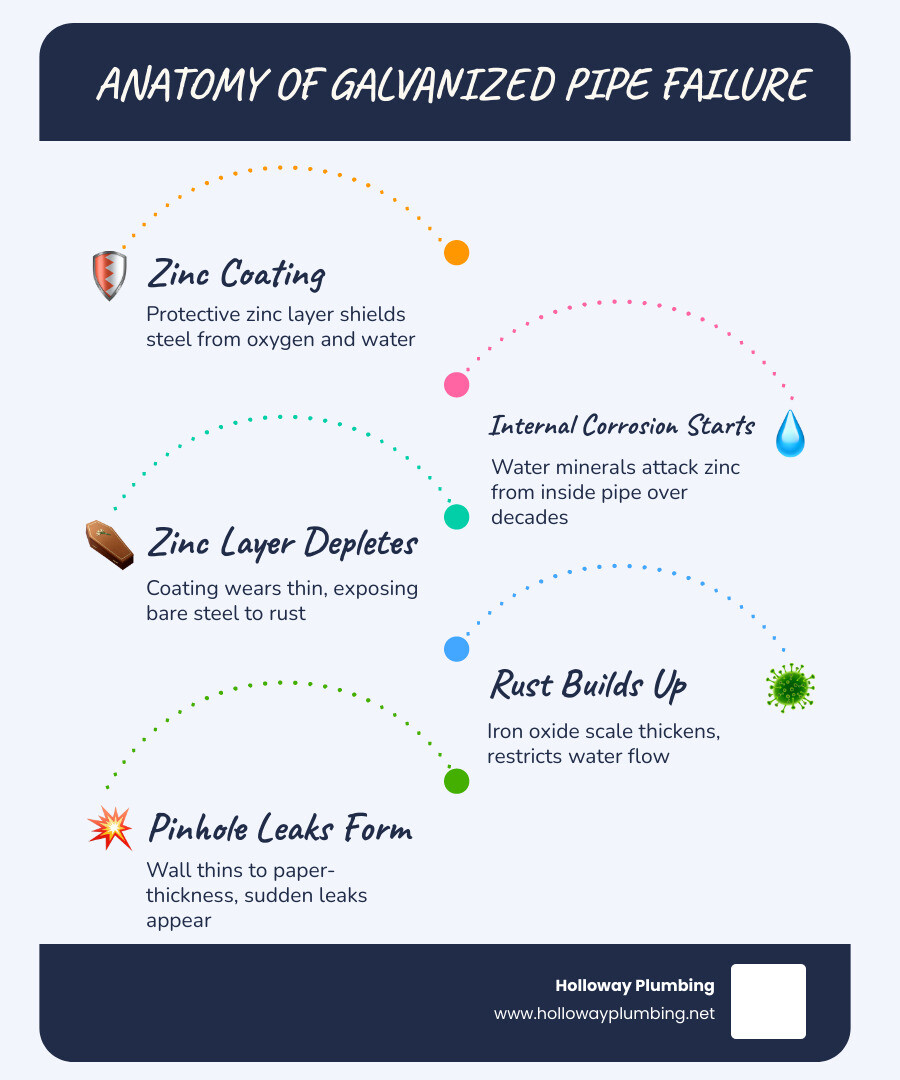
Galvanized pipes were once a common choice for home plumbing. They are steel pipes coated with zinc, which helps slow down rust and extend their life. The catch is that the protective coating breaks down from the inside over time. Leaks often show up late, when the pipe wall has already become very thin.
Old galvanized pipe is often corroded and brittle. Trying to tighten a fitting can crack it or break it in two. That is not alarmism. It is a common problem plumbers run into in homes built before the 1960s.
If your pipes have reached that point, a clamp may buy you time. But understanding why galvanized pipes fail helps you make smarter decisions about when to patch and when to replace.
At Holloway Plumbing, we’ve seen every stage of galvanized pipe failure in Texas Hill Country homes – from a single pinhole leak to whole systems that were ready for a full repipe. In this guide, you’ll learn how to repair galvanized pipe the right way, whether you need a quick temporary fix or want to know when it’s smarter to bring in a professional.
How to Identify and Safely Handle Aging Pipes
Before you grab your wrenches, you need to confirm exactly what you’re working with. Many Hill Country homes in Kerrville or Fredericksburg feature a mix of plumbing materials added over decades of renovations.
How to Identify Galvanized Pipe
Identifying galvanized steel is relatively simple:
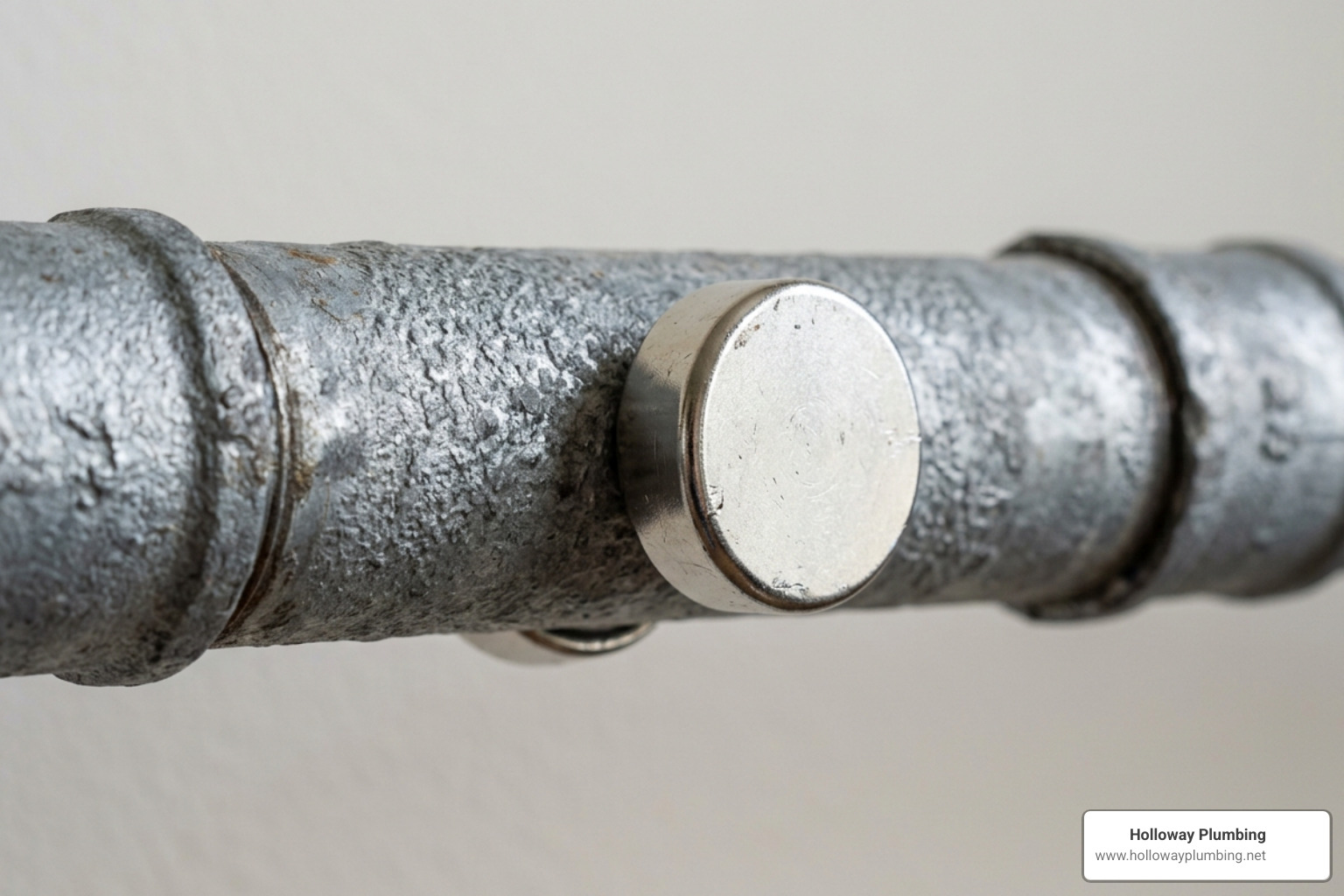
- The Magnet Test: This is the gold standard. A magnet will stick firmly to galvanized steel but will not stick to copper or plastic.
- Visual Inspection: Look for a dull, silver-gray color. Older pipes often have a “bumpy” or “pockmarked” texture due to the galvanization process and external corrosion.
- The Scratch Test: If you gently scratch the surface with a screwdriver, the scratch will be silver in color (unlike the penny-orange of copper).
However, identifying the pipe is only half the battle. You also need to know if the leak you see is the only one. Often, a visible drip is just the tip of the iceberg. For hidden issues behind walls or under slabs, More info about leak detection services can help pinpoint problems before they cause structural damage.
Safety Precautions Before You Begin
Working on old steel pipes isn’t like working with modern PEX. It requires muscle, patience, and a few safety ground rules:
- Shut Off the Water: Never attempt to repair galvanized pipe while it is under pressure. Locate your main shut-off valve and drain the lines by opening the lowest faucet in the house.
- PPE is Mandatory: Wear heavy-duty gloves and safety glasses. Old pipes can have razor-sharp edges, and cutting into them can release rust particles and metal shards.
- Lead Concerns: Many older galvanized systems used lead-based solder at joints or were connected to lead service lines. You can learn more about the risks of lead in drinking water from the EPA. Avoid breathing in dust when cleaning threads.
- Electrical Grounding: In many older homes, the metal plumbing system serves as the electrical ground. If you cut a section out, you could technically break that ground. If you’re unsure, consult an electrician.
- The “Snap” Risk: Old galvanized pipe is notoriously brittle. If you apply too much torque to a rusted fitting, you might snap the pipe off inside the wall, turning a small repair into a major reconstruction project.
Tools Needed to Repair Galvanized Pipe
To do this job like a pro, you’ll need a specific kit:
- Two large pipe wrenches (one to turn, one to “back up” or hold the pipe steady)
- Reciprocating saw with a metal-cutting blade
- Wire brush (for cleaning threads)
- Propane torch (to help loosen “frozen” or rusted-on couplings)
- Thread sealant or PTFE (Teflon) paste
| Feature | Hacksaw | Reciprocating Saw |
|---|---|---|
| Speed | Slow (10-15 mins per cut) | Fast (under 2 mins) |
| Effort | High manual labor | Low manual labor |
| Precision | High in tight spaces | Moderate (can jump) |
| Access | Needs wide swing room | Fits in narrow wall cavities |
Quick Fixes to Repair Galvanized Pipe Leaks
If you have a pinhole leak and can’t replace the section immediately, a temporary fix can buy you a few days or weeks. These methods work best on the straight “runs” of the pipe, not at the joints.
When to Use Clamps vs. Epoxy
- Pipe Repair Clamps: These are the most reliable temporary fix. They consist of a metal sleeve and a thick rubber gasket. You wrap the gasket over the leak, slide the sleeve over it, and tighten the bolts. This creates a mechanical seal that can handle standard household water pressure.
- Epoxy Putty: This is a two-part material you knead together and press over a dry, clean leak. It’s great for tiny pinholes, but it requires the water to be completely off and the pipe to be bone-dry to adhere.
- Silicone Tape: Self-fusing silicone tape can be wrapped tightly around a pipe. It works by tension, so you have to overlap it several times. It’s a “emergency-only” fix while you wait for a plumber to arrive.
For help with these high-pressure situations, see water line repair.
How to Repair Galvanized Pipe at Threaded Joints
Leaks at the joints are common because the threading process thins the pipe wall by more than half. To fix a joint leak:
- Clean the Area: Use a wire brush to remove external rust.
- Loosen and Inspect: If the joint is leaking, the sealant has likely failed. You’ll need to unscrew the fitting, clean the male threads with a wire brush, and apply fresh PTFE paste.
- Tighten Carefully: Use two wrenches. Hold the pipe steady with one while tightening the fitting with the other. Do not over-torque. If it doesn’t seal with moderate pressure, the threads are likely too corroded to save.
Step-by-Step Guide to Permanent Section Replacement
When a pipe is too far gone for a clamp, you have to cut the bad part out. This is where most DIYers get nervous, but if you follow the “two-cut method,” it’s manageable.
Cutting and Removing Damaged Steel
- The First Cut: Use your reciprocating saw to cut through the middle of the damaged section.
- The Second Cut: If you are removing a whole length between two fittings, make your cuts a few inches away from the threaded joints.
- Removing the Stubs: Once the middle section is gone, use your pipe wrenches to unscrew the remaining “stubs” from the existing fittings.
- Dealing with Frozen Joints: If a coupling won’t budge, heat it with a propane torch for about 30-60 seconds. The heat causes the metal to expand, often breaking the “rust weld” holding it together.
If the damage extends too far, you might be looking at a larger project. You can find more info about water line replacement to help you decide if you’re ready for a full section swap.
Installing New Pipe and Fittings
Since you cannot easily thread a pipe that is already inside a wall, you generally replace the removed section with a new piece of pipe and a union or a specialized transition coupling.
- Clean existing threads: Use a wire brush until the metal shines.
- Apply Sealant: Use a high-quality pipe dope or PTFE paste.
- Install the New Section: Screw in your new galvanized nipple or pipe section.
- Test for Leaks: Turn the water on slowly. Keep a bucket underneath and watch the joints for at least 15 minutes.
Transitioning to Modern Materials: PEX, Copper, and PVC
Most modern repairs don’t involve putting more galvanized pipe back in. Instead, we transition to materials like PEX or copper, which are easier to work with and won’t rust.
Water Supply vs. Drain Line Repairs
- Water Supply Lines: These are under high pressure. You must use threaded adapters to transition from galvanized to PEX or copper. Use a dielectric union if connecting directly to copper to prevent “galvanic corrosion” (an electrical reaction between different metals that causes rapid rusting).
- Drain and Waste Lines: These are gravity-fed and not pressurized. You can often use shielded Fernco couplings (rubber sleeves with stainless steel bands) to bridge the gap between old galvanized drains and new PVC.
If you suspect a leak beneath your home’s foundation, learn more about slab leak repair, since these jobs often require specialized transition techniques.
Preventing Galvanic Corrosion
In Texas Hill Country water, especially in Boerne and Fair Oaks Ranch, mineral-heavy water can speed up galvanic corrosion. When copper connects directly to galvanized steel, the steel usually breaks down faster. Use a dielectric union or plastic spacer to keep the metals electrically separated and help slow corrosion.
When to Stop Repairing and Start Repiping
There comes a point where to repair galvanized pipe is like trying to patch a screen door in a submarine. If you’ve had more than two leaks in a year, or if your water pressure has slowed to a trickle, the system is telling you it’s finished.
Signs It’s Time to Repipe:
- The 50-Year Mark: Most galvanized systems were designed to last 40-50 years. If your home was built before 1970, you’re on borrowed time.
- Discolored Water: Yellow or brown water, especially after the taps have been off for a few hours, indicates internal rusting.
- Low Water Pressure: Rust buildup (scale) inside the pipe restricts flow. If your shower feels like a leaky watering can, the pipes are likely “occluded” or closed up.
- Recurring Slab Leaks: If you’re constantly spotting the signs of a slab leak, the pipes under your foundation are failing.
The Risks of Welding Galvanized Steel
Some folks ask if they can just weld a patch onto a galvanized pipe. The answer is a hard no. Welding galvanized steel releases zinc oxide fumes, which are highly toxic and cause metal fume fever. Furthermore, the intense heat destroys the protective zinc coating on the inside of the pipe, causing it to rust even faster than before.
Long-Term Prevention and Maintenance
If you still have some galvanized pipe in your home, you can extend its life by:
- Installing a Water Softener: Hard water accelerates scale buildup.
- Pressure Regulation: Keep your home’s water pressure between 40-60 PSI. High pressure stresses weakened pipe walls.
- Routine Inspections: Once a year, walk your crawlspace or basement and look for “white fuzz” (calcium buildup) on joints, which signals a slow, evaporating leak.
Frequently Asked Questions about Galvanized Pipe
Can I use PVC glue on galvanized pipes?
No. PVC glue works by chemically melting plastic to create a solvent weld. It has zero bonding capability with metal. To connect PVC to galvanized, you must use a threaded male or female adapter or a mechanical coupling like a Fernco.
Why is my water brown after a repair?
Whenever you cut or bang on galvanized pipe, you dislodge “scale”—flakes of rust and minerals—from the inside walls. After a repair, always remove the aerators from your faucets and flush the system through a large outlet like a bathtub or an outdoor hose bib for 5-10 minutes.
Is galvanized pipe safe for drinking water?
While it was standard for decades, it isn’t ideal today. As the zinc coating wears off, the steel rusts, and that rust can trap lead and other contaminants. If your pipes are old, we recommend a water quality test or, better yet, planning for a transition to PEX or copper.
Conclusion
Handling a galvanized pipe leak doesn’t have to be a disaster. Whether you’re applying a temporary clamp or cutting out a corroded section, the key is to respect the age and fragility of the material.
At Holloway Plumbing, we have been helping homeowners across the Texas Hill Country, including Kerrville, Bandera, and Boerne, for nearly 50 years. We understand how local water conditions and older homes can make galvanized pipe problems worse. If your DIY repair is turning into a bigger project, or those pinhole leaks keep coming back, we can help with a professional assessment and a lasting repair plan.
Contact our plumbing specialists and schedule your expert water line repair today and let us help you keep your home dry and your water flowing clear.